
What It Costs You to Wait
A garage door that won't latch shut, or one that closes three-quarters of the way and then shoots back up, isn't a problem that fixes itself. With storm season still active into November and afternoon downpours a near-daily event along the Emerald Coast, a door that won't seal means wind-driven rain gets into the garage, humidity swells anything stored against the walls, and salt-laden air accelerates rust on whatever metal is left exposed. A door stuck half-open overnight is also an open invitation to anyone walking by, and if a storm cell rolls through with that door ajar, wind can catch the panel and do real damage to the track, the opener arm, or the door itself. None of that gets better by waiting for drier weather — it gets worse, and usually more expensive.
What You're Actually Seeing
These two symptoms have different root causes, even though homeowners often describe them the same way:
- Closes partway, then reverses back up. This almost always points to the opener's safety reversal system reacting to something — a real obstruction, a false signal, or excess resistance it's reading as an obstruction.
- Won't close at all, no movement. This points toward a dead signal path — sensors not communicating, a disconnected opener, a dead remote or keypad, or a mechanical jam stopping the door before it even starts.
Either way, a technician works through the same checklist, starting with the cheapest and most common fix and moving toward the more involved ones.
Where the Check Starts
1. The Photo-Eye Sensors
Every opener made in the last few decades has two small sensors mounted near the floor on each side of the track. If their line of sight is blocked, dirty, or even slightly misaligned, the opener assumes something is in the doorway and refuses to close or reverses mid-close. In this climate, the usual culprits are condensation fogging the lenses after a humid night, spiderwebs (common in garages that stay open during warm evenings), or low afternoon sun glaring directly into one sensor. The fix is simple: wipe both lenses, check that the indicator lights on each sensor are solid rather than blinking, and nudge the brackets until they're pointed at each other dead level. This solves the problem more often than anything else on this list.
2. The Track and Rollers
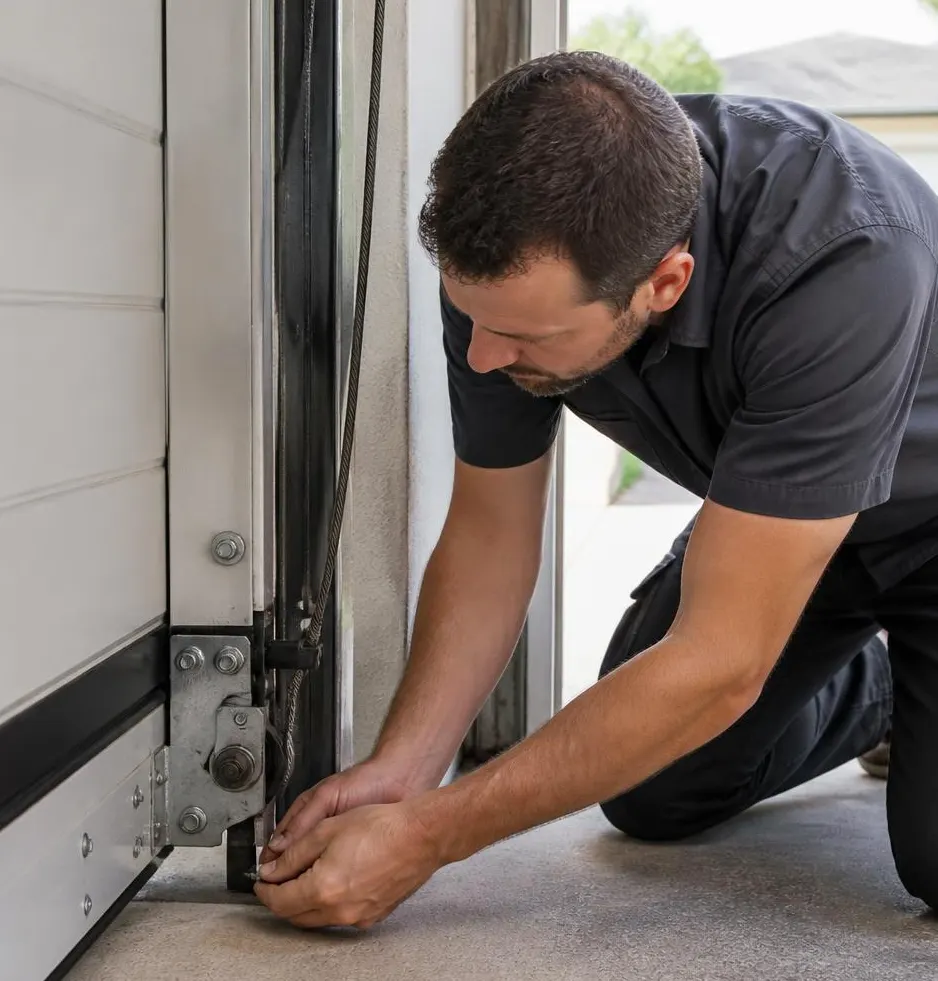
Next comes a visual pass down both tracks for anything knocked loose, bent, or corroded. Garages near the coast see faster rust buildup on tracks and rollers thanks to salt air, and a rusted or slightly bent section can cause enough friction or misalignment to trip the opener's resistance sensor or physically stop the door. The fix ranges from a simple track cleaning and lubrication to replacing a bent section or worn rollers.
3. Opener Limit and Force Settings
Every opener is programmed with a travel limit (how far the door should move) and a force setting (how much resistance it tolerates before assuming an obstruction). Humidity swings common on the coast can change how a wooden or composite door sits in its frame throughout the year, as panels swell slightly in wet weather. If the opener's force setting hasn't been adjusted to match, it may read normal friction as an obstruction and reverse. A technician resets these limits to match the door's current behavior rather than leaving factory settings in place indefinitely.
4. Wiring and Connections
Corrosion at wire connections, chewed insulation from rodents, or a loose connection at the sensor or opener head can cause intermittent signal loss — which shows up as a door that sometimes closes fine and other times won't budge. This is checked by testing continuity along the sensor wiring and at the opener terminal block, and repaired by cleaning connections or replacing damaged wire runs.
5. Springs and Cables
If the door feels unusually heavy, is noisy on the way down, or the opener strains audibly before reversing, worn torsion springs or a fraying cable are often the cause. A spring losing tension makes the opener do more work than it's rated for, which trips the force sensor as a false obstruction. Springs and cables exposed to salt air and humidity swings also corrode faster than inland installations, shortening their service life. This fix involves spring or cable replacement — not a DIY job, given the tension involved.
6. The Opener's Drive System
Last on the list: a worn gear, slipping belt, or loose chain inside the opener itself. These parts degrade gradually, so symptoms usually build over weeks — a little more noise, a little more hesitation — before the door stops closing altogether. Repair means replacing the specific worn component or, if the opener is old enough, replacing the whole unit.
When to Call Fort Walton Beach Garage Door Pro
If you've wiped the sensors and the door is still reversing or refusing to close, it's time to get a technician out rather than keep testing it yourself — especially with storm season still in play. We'll start with a diagnostic check of the sensors and opener settings, then move into Garage Door Cable Repair or Garage Door Spring Repair if the issue turns out to be mechanical rather than electronic. Either way, you'll get a door that closes fully and stays closed, which matters a lot more once the next band of weather rolls in off the Gulf.
Call Fort Walton Beach Garage Door Pro today to get your door closing right before the next storm comes through.